Search for surreal art for sale in San Francisco and the results are mostly vintage paintings on resale sites, filed under the city where they now sit. A living artist’s own work is harder to find. This guide covers what surreal means, then the surreal work Terry Bauer makes.
Where surrealism comes from
The word “surrealist” was coined by the poet Guillaume Apollinaire in 1917. In 1924 André Breton, who led a group of poets and artists in Paris, defined the movement in his Surrealist Manifesto as “pure psychic automatism”. Tate describes it as balancing a rational view of life with the power of the unconscious and dreams.
Tate adds that its ideas spread across the world, and that some artists linked to the movement rejected the label. Surreal is a quality a picture has, not only a club an artist joined.
Tate also says the movement looks for wonder in the unexpected and the uncanny. That is a useful thing to look for when you browse: a picture that surprises you before it explains itself.
What makes a picture surreal
Guides give a practical test: believable, carefully rendered things placed in impossible situations. Dalí is the usual example, painting recognisable objects in illogical, dreamlike scenes. Magritte is cooler and wittier, splitting word from image, as in his pipe captioned “This is not a pipe”.
Tate also lists methods artists used to reach the unconscious, such as automatic drawing and scraping paint from a layered canvas.
Terry Bauer’s surreal work
Surreal is his own word. The bio on his site uses it for what he makes, and so does the one L’Original, a Montreal gallery, publishes for him.
The pieces below show two ways he gets there: a known picture changed, and a new picture that floats free.
Reworked pictures
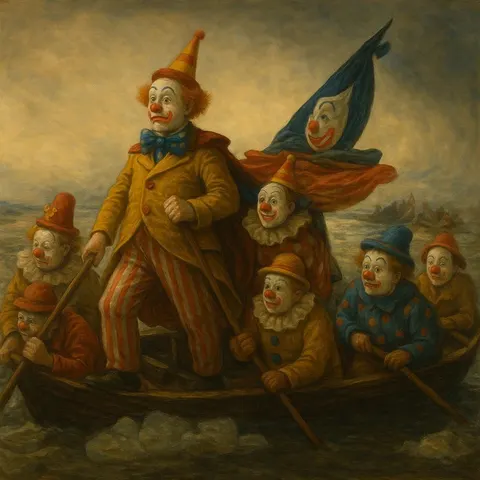
The photograph above is Clowns Crossing the Delaware, a boat of clowns in the pose of Washington’s famous crossing. Guernica reimagined puts Picasso’s painting in colour, with flying saucers and aliens overhead. Vistors seats grey aliens at the Last Supper.
Clergy Dogs, in the same group, dresses two dogs in Renaissance robes.
The recipe is the Dalí test turned sideways: a picture you know, with something impossible in it. More on that habit in the Klimt article.
Prints with an alien and a clown
His Klimt giclées include one with an alien and one with a clown. Both are in the shop: the alien and the clown. They are limited-edition giclées on archival paper, signed and numbered per order. The edition size is not on his site, so ask. The giclée guide lists what else to ask.
Because each print is signed and numbered per order, ask how long one takes to reach you, and whether paperwork comes with it.
A dreamlike floral
On the way to see the Wizard… shows large echinacea blooms on white, with orbs of light floating around them. His site ties it to Dorothy in the poppy fields. It is marked not for sale, but it shows the quieter end of his surreal side. It sits with the paintings on the work page.
What to ask before you buy surreal art
- Is this an original or a print?
- What is the medium, and the exact size?
- If it is a print, what is the edition, and which number would I receive?
- Is it signed, and will paperwork come with it?
- How will it be packed and delivered?
Ask about the exact image, because several of his works are untitled. Buying from a living artist means the person who made the work answers, about the piece in front of you.
Buying and asking
The shop lists what can be bought now, each work with its own page. For the rest, or any question about a work, the inquiry page takes it in one message.