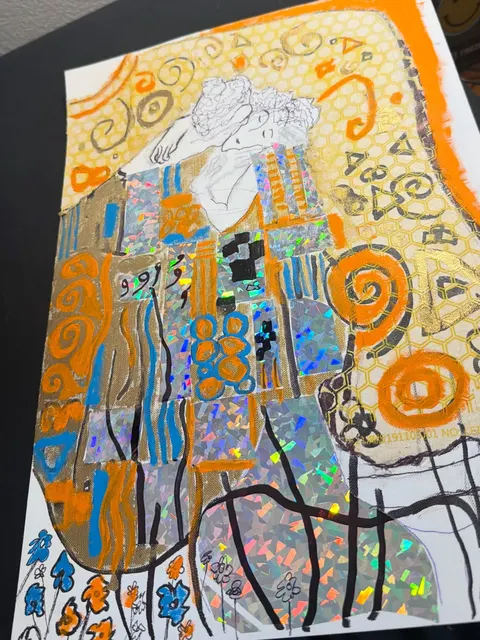
Klimt’s The Kiss has been remade many times. Search for a reimagined version and you find retail reproductions, parody prints, a gallery-world remake and a mural on a Vienna wall. Terry Bauer’s reimagined classics belong to that long habit of borrowing a famous picture and changing it.
Why artists rework The Kiss
The results show the range. Print shops sell whole collections of reinterpreted Kisses. Printmakers swap one of the lovers for a rabbit, for the joke. Jeff Koons set a reflective ball in front of a copy of it, so the viewer appears in the picture. In Vienna, a street artist painted it across the side of a building.
The point of each is the same: a famous image, changed enough to say something new about it, or about us.
What his reimagined classics are
His work includes a series of reimagined classics, which his site files under The NEXT Renaissance. Klimt is there, and so are Picasso’s Guernica (redone in colour, with flying saucers overhead), a run of Last Suppers (one with lizards at the table, one with aliens, one with wizards and pumpkins), Clergy Dogs, Other Worldly and Clowns Crossing the Delaware.
The Last Suppers are a series in themselves. Reptilians Last Dinner seats lizards along Leonardo’s table. Mythical Villains fills it with horned guests, Wizards Whips and Pumpkins with wizards, dragons and pumpkins, and Vistors with grey aliens. Clergy Dogs dresses two dogs in Renaissance robes, and Clowns Crossing the Delaware loads a boat with clowns in the pose of Washington’s famous crossing.
The Klimt pieces include four giclée prints. One puts a clown in the embrace, another an alien, a third gives the lovers green hair, a fourth sets them in black, white and gold Art Deco circles.
Mixed media on paper
The picture above is a Klimt of a different kind: a mixed-media work on paper that he posted to Instagram in April 2026. The embracing couple is a line drawing, laid over holographic foil, orange paint and honeycomb paper, so the gold of Klimt’s original becomes something that shifts as you move.
What a reimagined piece does
A reworked classic runs on recognition. You know the original before you have read the label, and then you notice what changed.
The pleasure is in the gap between the two: the clown where the lover should be, the reptile at the head of the table. The Last Suppers work the same way: everyone knows who sits at the centre of that table, which is exactly what makes a lizard in his place land.
Prints or originals
Some reimagined pieces are giclée prints, signed and numbered per order. Others hang in the reimagined classics series without a medium on the label. Whether a given image exists as an original, a print or both is the first thing to ask, so ask about the exact image.
Framing and display
Prints on paper are usually framed behind glass, which suits a bright wall. For a piece on paper with foil and layered paper, ask how it should be mounted and whether it is sensitive to light.
Questions to put to the artist
- Is this image available as a print, and in which sizes?
- Is the original a work on paper or a canvas?
- Is there more than one version of this scene?
- If it is a print, how many are in the edition?
See the series and ask
The reimagined classics hang in their own series on the work page, each at its own shape with a wall label. Tap one for a larger view, and use “Ask about this work” to send a question about it.