Some art is sold as a print you make yourself, others as a print made for you. They cost different things in time, quality and rights. This guide sets out the difference, the questions to ask of a printable file, and how Terry Bauer’s digital work fits.
What a printable art file is
Sellers of printable art, on marketplaces such as Etsy and Gumroad, offer a digital file the buyer prints. Listings say it can be printed at home or at a local print shop, and nothing ships.
What you get varies by seller: the listings in the results differ on file size and on what you may print. Read the listing for both before paying.
Resolution: what the numbers mean
Printing guides agree on 300 pixels per inch at the final size. A file for an 8 × 10 in print therefore needs about 2400 × 3000 pixels. Some sources accept 150 for large prints viewed from a distance.
Check the pixel size of the file against the size you want before you buy. A small file stretched to a large print looks soft.
Printing at home or at a shop
Guides say home inkjet printers suit smaller sizes and short runs, commonly up to 13 × 19 in, and advise archival paper and colour calibration. Print shops offer larger formats, other materials and colour matching, and may want a particular file type.
Either way, prepare the file at the print size, with a colour profile the printer accepts.
The licence
Most printable-art listings come with a personal-use licence. Sellers say it covers printing for your own walls or gifts and bars selling prints. Commercial use, such as products or advertising, is sold separately. Some sellers say a larger size needs permission.
Keep a copy of the licence with the file, so the terms are on hand whenever you print it.
Before you print
Do a trial first. Guides describe keeping a home printer for proofs and small prints, and sending large work to a lab. A small test on ordinary paper shows colour and sharpness cheaply.
Then choose the paper. Guides advise archival-quality paper for work you mean to keep, and colour calibration if the colours matter to you.
How a giclée differs
A giclée is made for you, from the artist’s file, on archival paper. Terry Bauer’s are limited editions, signed and numbered per order, so the print arrives with the artist’s mark and a place in a run. A printable file hands you the image and leaves the printing to you.
Neither is better, and they are not the same purchase. A file suits someone who wants a particular size at once and is happy to print it. A giclée suits someone who wants it signed and numbered. The giclée guide covers what to ask.
Which should you choose?
Think about what you want in the room. If the size, the paper and the speed are yours to decide, a file gives you that. If the signature and the number matter, a giclée does.
A file also asks something of you: a printer or a trip to a shop, and a little testing. Weigh that against waiting for a made-to-order print.
Digital art by Terry Bauer
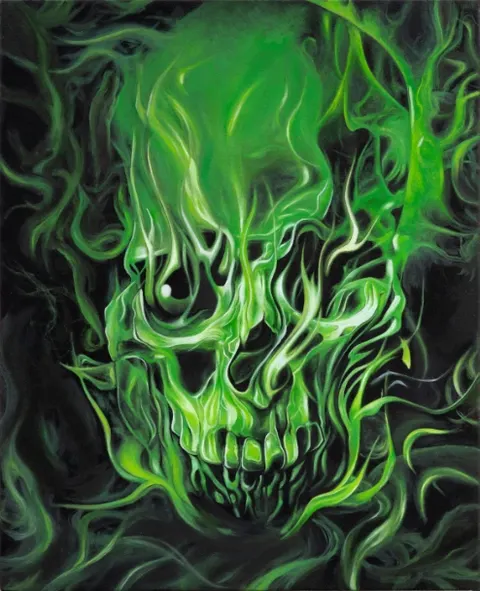
His work includes digital art and digital prints. His site doesn’t say which pieces are digital, so ask about any one. The listing for Supreme Demon, a skull in green flame on black, reads “click and print, no shipping required”. It has its own page.
What to ask about a click-and-print file
His site does not say what the buyer receives, so ask:
- What file type is it, and in what pixel dimensions?
- What sizes will it print well at?
- What does the licence allow, and can I have it in writing?
- Is there a colour profile to use?
- Can I print it more than once?
Send them from the inquiry page. The shop lists the rest.