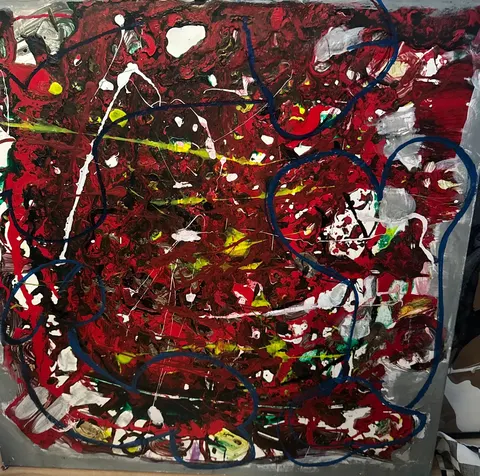
Search for original abstract art in San Francisco and most of what comes back is resale: marketplace listings of mid-century Bay Area painters, or global catalogues with a city filter. That suits some collectors. It leaves out the simplest route, which is asking a working San Francisco painter about a piece.
Why buy from the artist
Guides to buying art directly from artists make the same three points. More of the money reaches the person who made the work. You can ask about other pieces, older ones and what is coming next. And you can ask to see a work in person, or in better photographs, before you decide.
Buying direct is also a conversation rather than a checkout. You ask one person about one painting, and the answer comes from the person who made it.
What Terry Bauer paints
Terry Bauer paints in San Francisco. His abstracts are built from drips, pours and splatter, layer over layer, and the paintings group is labelled acrylic and encaustic wax. Power of 3, above, is red, black, grey and green, poured and splattered over a silver ground and ringed with loops of dark blue.
Alongside the abstracts he reworks famous pictures (Klimt, Picasso’s Guernica, the Last Supper) and makes prints and posters. Each has its own series on the work page.
A gallery in Montreal, too
L’Original, a gallery in Montreal, lists his originals under his tag name, 13auer. For a collector in Canada, or anyone who prefers to buy through a gallery, it is a second route to the same work.
What to ask before you buy an original
Whoever you buy from, the same few questions help:
- What is the medium, and what are the dimensions?
- Is it signed, and will there be paperwork with the artist’s signature and the date? Buying guides recommend keeping it, for insurance and for any later sale.
- Is the piece still available?
- How will it reach you? Moving a painting carries a real risk of damage, so ask how it will be packed and who handles delivery.
Delivery and payment are worth settling before anything else, so put those questions in your first message rather than your last.
How to ask
The inquiry page has one short form. Name the piece, or describe it, since several of his works are untitled. Say whether you want an original, a print or something else, and leave an email. If you arrive from a work’s wall label, the piece is already filled in. A phone number is optional, for when you would rather talk.
You don’t need to have decided anything. A question about size, medium or a work you saw on his Instagram is a normal first message.
Look first
The work page hangs everything on one wall: the paintings, the reimagined classics and the prints. Each has a label with what is known about it, title, medium, size and status, and a red dot on what has sold. Browse it, tap a work for a larger view, then ask about the one that stays with you.
Original, print or poster
Not every buyer wants an original. His prints are archival giclées on paper, signed and numbered per order, and the SF HEAD poster comes in four sizes and finishes. A print reproduces an image; an original is the object itself, and the two are described and priced differently for that reason.
If you are unsure which you want, say so. Name the image and ask which versions exist.
A short checklist for your message
- The work’s title, or a description of it.
- Original or print.
- Medium, size and signature, if you want them confirmed.
- How you would like the piece to reach you.
- A phone number, only if you would like a call.
Send it from the inquiry page, and Terry will reply to the email you give.