A salon-style wall packs pieces of different sizes close together, so the group reads as one shape. It suits a mix of an original or two and a handful of prints. These are the rules the guides agree on, and the sizes of Terry Bauer’s work to plan with.
Think of it as one shape
Guides treat the whole arrangement as a single rectangle. Plan the outline first and fill it in, instead of hanging pieces one at a time and hoping they meet.
Mismatched frames are normal on a salon wall. What holds it together is even spacing.
Start with the largest piece
Begin with one big anchor and build outward. Among the originals named here, the largest is Richard Schlop, at 20 × 24 in on wrapped canvas, on its shop page. If the wall is big, the 36 × 36 SF HEAD wall vinyl is larger still, and could anchor a group of its own.
Hang the anchor first, then place smaller pieces around it. Small works fill the gaps. Yo/duh!, at 10 × 8 in, is the kind of size that tucks beside a larger piece.
Where the centre goes
Most guides put the centre of the whole arrangement at 57 to 60 in from the floor, not at the height of your own eyes. Personal eye level tends to hang art too high, especially under tall ceilings. Measure from the floor, mark the centre, and plan the rectangle around that mark.
Keep the gaps equal
Frameology recommends 2 to 3 in between every frame. Other guides allow up to 4 in for a looser salon mix. Whichever you pick, keep it the same all the way round. It matters most when sizes differ as much as 10 × 8 and 20 × 24. Consistent spacing matters more than matching frames.
Test with paper templates
Trace each frame onto kraft paper or newspaper, cut it out and tape it to the wall. You see the whole layout, move it around, and put no nail in the wall until it works. Mark the nail positions through the paper, then take it down and hang the real pieces.
Check each with a level. A template also shows where a rectangle such as SF HEAD’s 12 × 18 print sits best among the squares.
Odd numbers
Guides also note the rule of odds: groups of three, five or seven feel more lively than even ones. It is a guide, not a law.
Sizes to plan with
Known sizes help you cut templates before you buy. Richard Schlop is 20 × 24 in and Yo/duh! is 10 × 8 in. SF HEAD comes as 12 × 12, 12 × 18 and 20 × 20 in and, as a wall piece, 36 × 36 in; see its page.
The giclée prints are on archival paper, signed and numbered per order, and their sizes are not on his site. Ask before you cut a template.
Originals beside prints
The guides on gallery walls cover frames and spacing, not how to treat an original differently from a print. Framing guides do say works on paper usually go behind glass with a mat or spacer, and canvases usually go without.
So ask the artist how a piece should hang, and whether it needs glass.
Building the wall
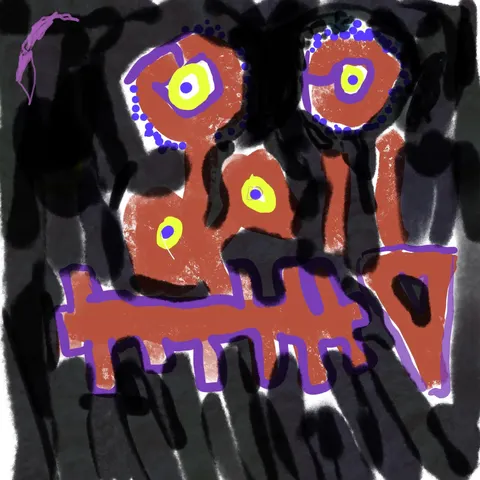
The photograph shows Positive Space, a giclée print: two yellow eyes over orange and violet shapes on black, with its own page. The four Klimt-reimagined giclées are variations on one scene, so they read as a set. With Positive Space they make five, an odd number. Start with one piece, and add as the wall asks.
Before you drill, run through the short list:
- Cut and tape templates for every piece.
- Centre the arrangement at 57 to 60 in.
- Keep every gap the same.
- Level each piece as it goes up.
Everything on sale is in the shop. Questions about size or framing go through the inquiry page.