Search for drip paintings for sale and the results are mostly listings that say “in the style of” or “after” Jackson Pollock. Some are vintage, some are made to order, some are decor. This is a short guide to what the phrase means, what to check, and where Terry Bauer’s drip work fits.
Where drip painting comes from
Pollock worked horizontally. MoMA’s conservators describe him laying unstretched canvas on his studio floor and flinging and dripping thinned enamel paint onto it. For Number 1A, 1948, they note, he abandoned the easel altogether and layered handprints, brushwork, then poured and dripped paint.
A 2019 Brown University study, reported by Phys.org, looked at the physics of it: he made his best-known works not with a brush but by pouring paint onto the canvas from above.
What “inspired by” tells you
Many listings say “in the style of” or “after” Pollock. That wording means the work is not by him. It is honest, and it is the right thing to look for.
A work that says it is inspired by Pollock is telling you where its method comes from, not claiming his hand. Labels and descriptions don’t always agree: one listing in the results carries a “by” label above a description that says “in the style of”.
Read the whole description, not only the title.
Richard Schlop
His site calls Richard Schlop a chaotic, Jackson Pollock–inspired composition, with primary colours dripped, smeared and thrown across the canvas. It is on wrapped canvas, 20 × 24 in.
It has its own page in the shop, where the photograph shows blue, black and yellow drips over pink.
Power of 3
Power of 3 is the second drip work in the shop. His site names its colours as red, black, grey and green, and describes them as converging in a visual rhythm. In the photograph, red and black paint is poured and splattered over silver and ringed with dark blue loops. See it on its own page.
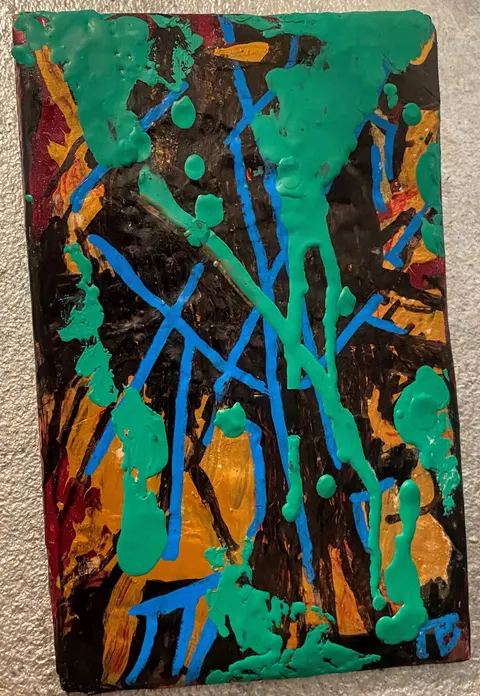
The picture above is a third, an untitled panel that is not for sale: green paint dripped over black and gold, crossed with blue lines. The three look nothing alike. A drip is a method, not a look.
Drips in other places
The drip shows up in more than one format. On his site, the SF HEAD collection carries the line “Collection inspired by drips drops and splats.” And his page at L’Original, a Montreal gallery, groups work in a collection called “On cotton rag”, described as drips, drops and splatters on cotton rag paper. One work there is titled Monochrome Drip Composition.
Canvas, paper and poster are three different things to hang. Ask which one a given piece is.
The shop page for each work repeats what his site states about it. Start there, and ask about anything the page leaves out.
What to ask before you buy
- Is it an original, or a print of one?
- What is the medium, and the exact size?
- Is it signed, and where?
- How should it hang, and how is it shipped?
- Will there be paperwork with the signature and the date? Buying guides recommend keeping it, for insurance and any later sale.
- Is it still available? The work page marks what has sold and what is not for sale.
A photograph shows colour well and thickness badly. If the surface matters to you, ask for a close view.
Original or print
A print reproduces an image. An original is the object itself, and the two are described differently for that reason. If a drip work you like exists only as the original, a print of something else may serve the same wall. Ask which versions exist, and how each is signed.
Where to look
The shop lists the works in it. The work page shows more, with labels. For a question about either, the inquiry page takes it in one message.